Hugo
Three SecondsHugo is Piet Hoffmann and Zofia’s five-year-old son, Rasmus’s older brother, and one of the clearest measures of what Piet’s dangerous work places at risk. The novel presents him through small domestic encounters rather than through an independent plot: he wakes early, notices his parents’ strained manner, asks questions, and expects his father to return to ordinary family life. His presence makes Piet’s divided existence tangible, because the same hands that manage covert preparations also fasten Hugo’s seat belt, put him to bed, and kiss his cheek.
Identity and family life
Hugo is the elder of the two boys. Rasmus is three, while Hugo is five; the distinction appears in their different car seats and in the way their father handles them. When Piet comes to collect the children, Hugo’s greeting is part of an eager reunion that lifts his father’s spirits. Later, Piet straps Hugo into the higher, firmer seat and secures the belt, while Rasmus occupies a rear-facing child seat. These practical details establish the boys’ ages and dependence without separating them from the everyday work of caring for them.
The family’s routines recur around illness. After the children develop fevers, Piet collects them from Hagtornsgården preschool and takes them home. They fall asleep holding unread comics, and he tells Zofia he will stay with them. At another point, the boys are still feverish beneath white duvets; Piet watches them sleeping and kisses each forehead. Their illness makes his attention immediate and physical, but the scene’s deeper significance lies in what it draws out of him: he recalls life before the children and recognizes that the concerns which once seemed absolute have lost their hold beside the love he feels for them.
A child’s attention to adults
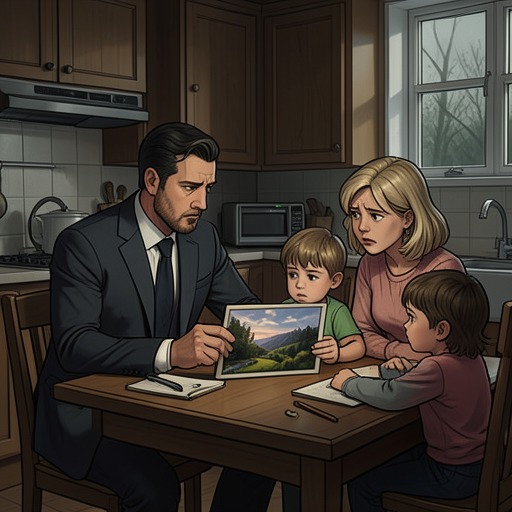
Hugo is not merely a passive presence in the household. At breakfast, after the parents have resumed an ordinary meal of porridge, yogurt, crispbread, and juice, he asks why they are angry with each other. Piet and Zofia exchange a glance and deny that they are angry. Hugo’s question does not establish what he understands about their difficulties, but it shows that their strained relationship is visible enough for him to notice. The ordinary breakfast setting makes the moment sharper: family routine continues, yet a child has registered a change in its emotional weather.
His alertness also appears in the way he listens to his father. Rasmus can already distinguish the two languages Piet uses and associate them with different purposes; Hugo, too, demonstrates that he can speak Polish. He begins counting in Polish and then continues in a darker voice in English. The brief exchange places language within family life as something the children observe and use, rather than a private tool belonging only to Piet’s adult world. Hugo’s switch is playful, but it also sits beside the father’s effort to keep work and home separate: the children are already attentive to the signs by which he divides those worlds.
The home crossed by covert work
Piet’s hidden work enters the domestic setting through objects and interrupted moments. While preparing a hollow space inside a thick copy of Lord Byron to conceal amphetamine, he is approached by Hugo, who asks what he is doing. Piet presents the activity as reading and redirects him toward a television programme, which Hugo reports has ended. The scene does not suggest that Hugo understands the book’s purpose. Its importance is the contrast between the child’s uncomplicated question and the dangerous concealment being carried out within his reach.
Other household details sharpen that contrast. A table that had recently held explosive materials and a loaded gun is later set for breakfast, where the family eats amid spilled juice and the clatter of cereal. At bedtime, Hugo and Rasmus have pancakes with strawberry jam and too much whipped cream before Piet opens their windows and watches them fall asleep. These are not separate from the threat around Piet; they show how thoroughly he must move between it and routine care. The same home contains both the ordinary ceremonies of childhood and the materials of an operation that cannot safely be explained to the children.
Separation and narrative significance
Hugo’s presence gives emotional weight to Piet’s movements into prison, although the narrative does not establish what Hugo knows about the reasons for his father’s absence. Piet enters Aspsås prison under restraint and undergoes its controlled intake; after ten days, he has spent twenty-three hours of each day alone in a small cell, without visitors or ordinary sources of news. When he is introduced to the unit, he must learn its rules and accept that the cell is now his home. These prison scenes describe Piet’s circumstances, not Hugo’s understanding of them, but they make the separation between father and child concrete.
That separation is especially consequential because the book has established Hugo through touch and routine: Piet lifts him, kisses his cheek, notices his fever, and watches him sleep. The child’s question about his parents’ anger and his interruption at the concealed book also mark how family life can brush against pressures Piet is trying to hide. Hugo does not direct the criminal or prison plot, and the evidence does not give him a resolution of his own. Instead, he remains one of its most personal stakes: the son Piet longs to protect, whose ordinary needs expose the cost of maintaining a life divided between home and danger.